



Morning Glory Flowers & the Sensual Realms of the Fairy Queendom

Updated: Apr 16

Morning Glory Flowers and the Faerie Veil: Gateways to Imagination, Sensory Awareness, and Expanded Consciousness
In the quiet hush of dawn - when perception softens and the natural world shifts between night and day - the morning glory unfurls her trumpet-shaped blossoms to greet the first light of the rising sun. This climbing vine, spiraling upward in elegant, rhythmic motion, has been regarded across cultures as a symbol of transition, renewal, and the meeting point between visible and unseen worlds.
Her delicate petals, intricately veined and responsive to the morning light, open in a fleeting yet intentional cycle - closing again as the day matures. This ephemeral blooming pattern has long invited reflection on the relationship between darkness and illumination, rest and awakening, inner experience and outward expression.
Within artistic, mythological, and ethnobotanical traditions, the morning glory has been associated with liminality: thresholds of perception, imagination, and sensory awareness. As such, it offers a compelling botanical metaphor for exploring altered states of consciousness - not as escapism, but as a means of deepening connection to self, environment, and creative insight.
In this way, the morning glory becomes more than an ornamental flower; it is a living symbol of cyclical awakening, inviting a nuanced dialogue between sensual experience, ecological awareness, and the subtle dimensions of human perception.

Morning Glory Flowers and the Sensual Realms of the Fairy Queendom
Throughout cultural history, the morning glory has been associated with the subtle and often unseen dynamics of the natural world, its spiraling growth pattern reflecting motifs found in folklore, ecology, and embodied spirituality. Within European folk traditions and the teachings of wise women and mystics, such plants were often understood as markers of liminal space - thresholds where imagination, intuition, and the more-than-human world meet.
In these traditions, what is referred to as the “fae” can be understood not only as mythic beings, but as symbolic representations of nature’s intelligence, fluidity, and responsiveness. The winding tendrils of the morning glory, ever-reaching and coiling, mirror patterns found throughout the natural world - spirals in water currents, shifting air flows, and botanical growth itself. These forms have long been associated with processes of transformation, initiation, and cyclical renewal.
Rather than existing outside of reality, these narratives invite a different mode of perception - one that is attuned to rhythm, sensation, and relational awareness. The “in-between” spaces described in folklore can be interpreted as states of heightened presence, where sensory experience, imagination, and ecological connection become more vivid and intertwined.
Through this lens, the morning glory becomes an evocative guide - an embodied metaphor for engaging with the world in a way that honors both sensual experience and subtle awareness, while remaining rooted in the living systems that surround us.

Morning Glory Flowers in Myth, Magic, and Ritual
Morning glories have been honored across diverse cultural and historical contexts, particularly within Mesoamerican traditions. Among the Aztec and Zapotec peoples of what is now Oaxaca, certain species of morning glory - most notably Ipomoea varieties—have been used within ceremonial and divinatory practices for generations.
In these contexts, the seeds, referred to in some regions as semilla de la Virgen (“Seed of the Virgin”), have been regarded as sacred tools for insight, healing, and communication with the unseen. Ethnobotanical research has documented their use within carefully held ritual frameworks, guided by trained practitioners who understand both the spiritual and physiological dimensions of working with such plants.
Rather than functioning as a generalized “gateway,” these practices are traditionally embedded within specific cultural lineages, where intention, preparation, and relational respect are essential. The experiences associated with these seeds have been described as visionary or introspective, often supporting processes of reflection, emotional insight, and connection to symbolic or archetypal imagery.
When approached through a contemporary lens, morning glory can be understood as a powerful symbol at the intersection of plant intelligence, cultural tradition, and altered perception. Engaging with this legacy invites not only curiosity, but also responsibility - honoring the origins of these practices while cultivating a grounded, informed, and ethical relationship to the plant world.
Morning Glory in Goddess Traditions
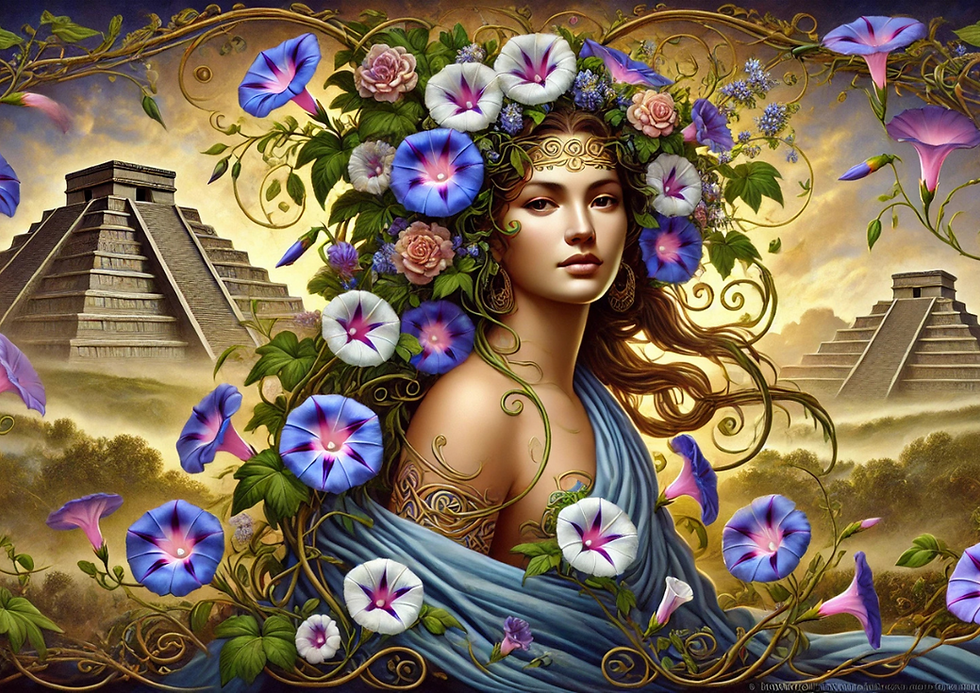
The Great Goddess of Teotihuacan - often interpreted by scholars as a central figure of fertility, water, and earthly abundance - is depicted in mural art adorned with cascading vegetal forms, sometimes understood to represent flowering vines. These images speak to a broader cosmology in which plant life mediates between the terrestrial and the celestial, rooting spiritual meaning in the living landscape.
Within Aztec tradition, the goddess Xochiquetzal, associated with flowers, beauty, sensuality, and creative expression, embodies the sacred dimension of pleasure and the generative forces of life. While not exclusively linked to the morning glory, her symbolism resonates with the flower’s ephemeral beauty and its invitation into heightened sensory awareness.
In Greek myth, floral adornment also marks moments of transition and descent. Figures associated with Persephone are often depicted gathering or wearing blossoms prior to her journey into the underworld - an act that has been interpreted as a symbolic crossing between innocence and initiation, surface and depth. While morning glory is not explicitly named in these classical sources, its cyclical blooming and closing echoes the mythic rhythms of descent and return.
Across these traditions, the presence of flowering vines and blossoms gestures toward a shared symbolic language - one in which plants serve as intermediaries between worlds, embodying cycles of sensuality, transformation, and renewal.

The Mystical Union of Morning Glory and Embodied Awakening
Just as the morning glory blooms at the first presence of sunlight, there is a natural rhythm of unfolding within human awareness - an opening that follows timing, environment, and inner readiness. Across many ancient traditions, flowers have been understood as symbols of generative life force: expressions of nature’s capacity for renewal, emergence, and form.
The morning glory, opening at the threshold between night and day, offers a living metaphor for this process of gradual awakening. Her cyclical blooming - unfurling with light and gently closing as the day progresses - reflects the importance of attunement rather than force. In this sense, she becomes a guide for understanding receptivity, patience, and alignment with natural cycles of change.
Within contemplative and somatic traditions, such patterns are often used as entry points for reflection on awareness and perception. The spiraling growth of the vine mirrors recurring motifs found in nature - patterns of expansion, return, and continuity. These forms have also been interpreted in various spiritual systems as representations of inner energetic movement and transformation, describing the way attention and consciousness can shift through layers of experience.
To engage with the symbolism of the morning glory in ritual or reflective practice is to enter into a relationship with cyclical time and embodied awareness. Her presence invites a kind of attentiveness to sensation, breath, and environment - encouraging a more intimate perception of the living world.
In this way, the morning glory becomes a teacher of rhythm and transition, offering insight into how awareness deepens not through intensity or force, but through alignment with the natural unfolding of experience.

Rituals and Practices for Entering the Enchanted Veil
For those drawn to the symbolic and contemplative qualities of the morning glory, there are many ways to engage with this plant in a respectful and grounded manner. In traditional and contemporary ecological spirituality, plants are often approached not as tools for consumption, but as living presences that invite relationship, observation, and reciprocal awareness.
One simple yet meaningful practice is dawn meditation beside a blooming morning glory vine. In the quiet of early morning, when light first begins to shift the landscape, one may sit in stillness and attune to the rhythm of the natural world - observing breath, sensation, and the subtle movement of life unfolding around the plant. In this way, the morning glory becomes a focal point for reflection on presence, timing, and receptivity.
Another practice involves cultivating morning glories in a garden space and creating a small reflective altar nearby. Such spaces can be designed as gestures of appreciation and reciprocity - offering objects from nature such as stones, shells, handwritten intentions, or symbolic items that carry personal meaning. Within ecological and folkloric traditions, these kinds of practices are understood as ways of deepening relational awareness with the more-than-human world.
While morning glory seeds have appeared in historical ethnobotanical contexts associated with visionary or ceremonial use, contemporary engagement with the plant can also be approached through non-ingestive, observational, and artistic pathways. This includes journaling, sketching the vine’s spiral growth, or reflecting on its cyclical blooming patterns as metaphors for transition, perception, and renewal.
Across all approaches, the emphasis remains on relationship rather than extraction - honoring the plant as a living participant in an interconnected ecosystem, and engaging with it through mindfulness, respect, and embodied presence.

Final Blessings: Walking the Path of Enchantment
To walk in conscious relationship with the morning glory is to enter a symbolic landscape where sensory awareness, imagination, and ecological presence meet. In this way, the flower becomes a companion for reflection - inviting us to consider how perception shapes our experience of the world, and how meaning arises through attention, reverence, and care.
This is a path of attunement: to rhythm, to season, and to the subtle intelligence of living systems. In mythic language, it may be described as a movement between worlds; in ecological terms, it can be understood as a deepening of relational awareness with the more-than-human environment. Both perspectives point toward the same invitation - to experience life with greater presence, sensitivity, and wonder.
The morning glory’s spiraling growth offers a reminder that transformation is often gradual, cyclical, and responsive to light. It suggests that insight does not arrive through force, but through alignment - through the willingness to observe, to listen, and to be changed by what we encounter.
In this spirit, we are invited to return again and again to the living world with humility and curiosity, recognizing that meaning is not imposed upon nature, but discovered through relationship with it.
Blessed be
Written with love and devotion by Renee Boje
References:
Books:
Beyerl, Paul. The Master Book of Herbalism. Phoenix Publishing, 1984.
Buhner, Stephen Harrod. The Secret Teachings of Plants: The Intelligence of the Heart in the Direct Perception of Nature. Bear & Company, 2004.
Cunningham, Scott. Magical Herbalism: The Secret Craft of the Wise. Llewellyn Publications, 1982.
Furst, Peter T. Hallucinogens and Culture. Chandler & Sharp Publishers, 1976.
Ratsch, Christian. The Encyclopedia of Psychoactive Plants: Ethnopharmacology and Its Applications. Park Street Press, 2005.
Academic & Ethnobotanical Studies:
Hofmann, Albert. LSD: My Problem Child. McGraw-Hill, 1980.
Wasson, R. Gordon. The Wondrous Mushroom: Mycolatry in Mesoamerica. McGraw-Hill, 1980.
Schultes, Richard Evans & Hofmann, Albert. Plants of the Gods: Their Sacred, Healing, and Hallucinogenic Powers. Healing Arts Press, 1992.
de Borhegyi, Stephan F. The Iconography of the Teotihuacan Goddess and Morning Glory Vines in Mesoamerican Mythology. Mesoamerican Studies, 1965.
Fairy Lore & Spiritual Traditions:
Silver, Ravenwolf. To Ride a Silver Broomstick: New Generation Witchcraft. Llewellyn Publications, 1993.
Matthews, Caitlín. The Faery Faith: An Integration of Fairy Traditions with Modern Paganism. Element Books, 1991.
McCoy, Edain. A Witch’s Guide to Faery Folk: Reclaiming Our Working Relationship with Invisible Helpers. Llewellyn Publications, 1994.
Herbal & Plant Spirit Medicine:
Wood, Matthew. The Earthwise Herbal: A Complete Guide to New World Medicinal Plants. North Atlantic Books, 2009.
Green, Susan Weed. Wise Woman Herbal: Healing Wise. Ash Tree Publishing, 1989.
Andrews, Ted. Enchantment of the Faerie Realm: Communicate with Nature Spirits & Elementals. Llewellyn Publications, 1993.


Comments